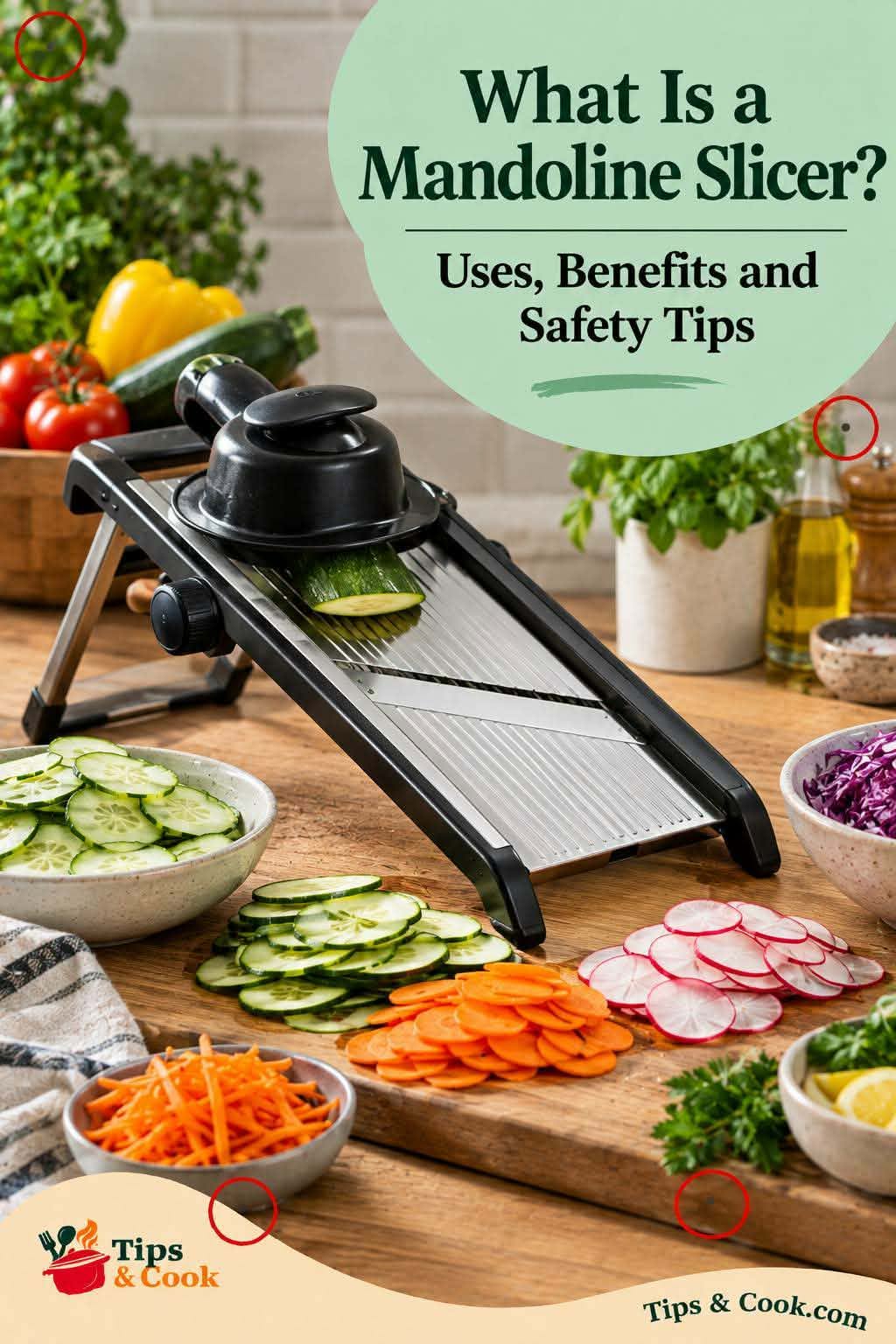
A mandoline slicer is a kitchen tool designed to cut fruits and vegetables into thin, even slices quickly. It uses a sharp, adjustable blade that allows you to control the thickness of each slice. Unlike a regular kitchen knife, a mandoline can produce consistent cuts with less effort, making it useful for preparing potatoes, cucumbers, onions, carrots, cabbage, and other foods.
If you often prepare salads, vegetable chips, gratins, or garnishes, understanding what is a mandoline slicer and how to use one safely can help make food preparation faster and more consistent.
What Is a Mandoline Slicer?
A mandoline slicer is a handheld or countertop kitchen utensil with a flat surface and a built-in cutting blade. Food is pushed across the blade, creating slices of a relatively uniform thickness.
Many mandoline slicers have adjustable settings that let you make very thin slices or thicker cuts. Some models also include interchangeable blades for julienne cuts, waffle cuts, or other shapes.
The main parts typically include:
- Cutting blade
- Food platform or surface
- Thickness adjustment
- Hand guard or food holder
- Supporting legs or a handle
Because the blade is extremely sharp, a mandoline should always be used with its safety features.
What Can You Use a Mandoline Slicer For?
A mandoline is particularly useful when you need many evenly sliced ingredients.
1. Slicing Potatoes
You can use a mandoline to cut potatoes for homemade chips, gratins, casseroles, and roasted dishes. Even slices can help ingredients cook more consistently.
2. Preparing Cucumbers
Thin cucumber slices work well for salads, sandwiches, pickles, and garnishes. A mandoline can create uniform slices much faster than cutting each piece with a knife.
3. Cutting Onions
A mandoline can produce thin onion slices for salads, burgers, sandwiches, and cooked dishes. Use the hand guard to keep your fingers away from the blade.
4. Slicing Carrots and Other Vegetables
Firm vegetables such as carrots, zucchini, radishes, and cabbage can be sliced efficiently with a mandoline. Some models can also create julienne-style cuts.
5. Making Vegetable Chips
Thin, consistent slices are useful when making homemade vegetable chips from potatoes, sweet potatoes, beets, or other suitable vegetables.
Benefits of Using a Mandoline Slicer
A mandoline offers several practical benefits for home cooks.
Consistent slices: The adjustable blade can produce slices with a more uniform thickness than manual knife cutting.
Faster preparation: Once you become comfortable using it, a mandoline can reduce the time needed to slice large quantities of vegetables.
Different cutting styles: Depending on the model, you may be able to create thin slices, julienne strips, waffle cuts, or other shapes.
Useful for meal preparation: Consistent cuts can make ingredients easier to portion and can help food cook more evenly.
Less repetitive knife work: A mandoline can reduce the amount of manual slicing required when preparing large quantities of ingredients.
How to Use a Mandoline Slicer Safely
The biggest concern when using a mandoline is its exposed sharp blade. Even experienced cooks can accidentally cut their fingers if they use one carelessly.
Follow these safety tips:
- Use the hand guard. Always use the food holder or hand guard whenever possible.
- Keep your fingers away from the blade. Never hold food directly against the cutting surface with your bare fingers.
- Place the mandoline on a stable surface. A secure position helps prevent slipping while you work.
- Start slowly. Focus on controlling the food rather than trying to slice quickly.
- Stop before the food becomes too small. Do not try to push a tiny leftover piece through the blade with your hand.
- Use cut-resistant gloves if appropriate. They can provide an additional layer of protection, but they should not replace the hand guard.
- Clean the blade carefully. Avoid running your fingers along the blade when removing food or washing the slicer.
- Store it safely. Keep the blade covered or store the mandoline where children cannot access it.
Mandoline Slicer vs. Kitchen Knife
A kitchen knife is more versatile because you can use it for many different cutting tasks and shapes. However, achieving perfectly uniform thin slices with a knife can take practice.
A mandoline is specifically designed for repetitive slicing and consistency. It can be especially helpful when you need a large number of evenly sized slices.
The choice depends on the task. For general chopping and cutting, a knife is usually more versatile. For fast, uniform slicing, a mandoline can be more convenient.
How to Choose a Mandoline Slicer
When choosing a mandoline, consider how you plan to use it.
Look for:
- Adjustable slice thickness
- A secure hand guard
- A stable base or non-slip feet
- Easy-to-clean parts
- A blade that can be safely stored
- Different cutting options if you need them
- A comfortable design that is easy to control
For occasional home cooking, a simple model may be enough. If you regularly prepare large quantities of vegetables, a sturdier model with multiple cutting settings may be more useful.
Frequently Asked Questions
Is a mandoline slicer worth having?
A mandoline can be useful if you frequently need thin, uniform slices of vegetables and fruits. It is less necessary if you rarely perform repetitive slicing.
Can a mandoline slicer cut meat?
Some specialized mandolines may be designed for particular foods, but most household mandoline slicers are primarily intended for fruits and vegetables. Always follow the manufacturer’s instructions.
Are mandoline slicers safe?
They can be used safely when handled correctly, but their blades are very sharp. Using the hand guard, keeping the slicer stable, and avoiding direct contact with the blade are important safety precautions.
Can you put a mandoline slicer in the dishwasher?
It depends on the model. Check the manufacturer’s cleaning instructions before putting any part in a dishwasher.
Conclusion
A mandoline slicer is a practical kitchen tool for creating quick, consistent slices of fruits and vegetables. It can be especially useful for salads, vegetable chips, gratins, pickles, and other recipes that require evenly cut ingredients.
However, its sharp blade requires careful handling. Always use the hand guard, keep the slicer stable, and never place your fingers near the blade. With proper technique and safe handling, a mandoline can make repetitive slicing much easier.